Car Lease Deals in Lee's Summit, MO: Lease or Buy?
Lease or buy in Lee's Summit? See how mileage, commutes from Grain Valley, and lease-end costs shape the smarter choice for your driving life.
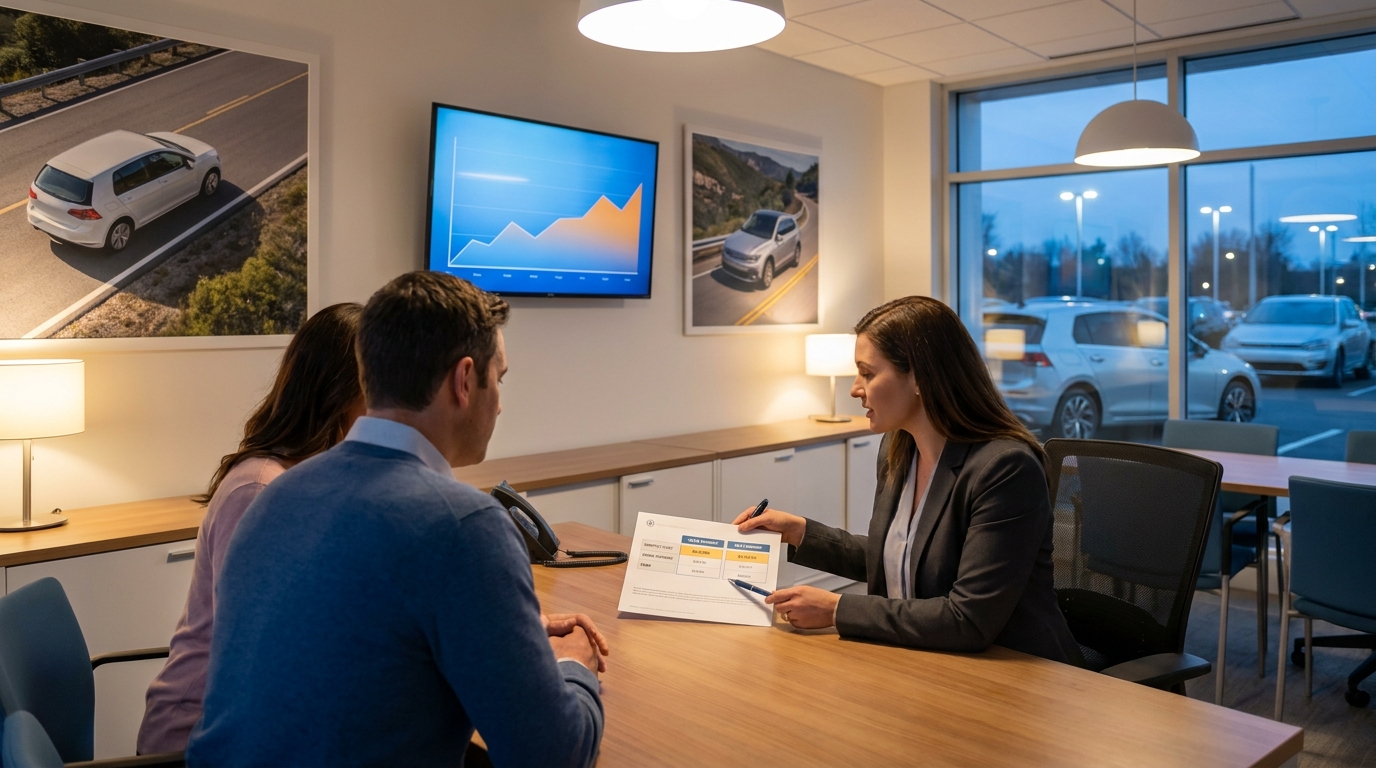
Lease if you drive predictable miles (under about 12,000-15,000 a year), want a lower monthly payment, and like being in a newer vehicle every three years. Buy if you commute long distances on Highway 50, US-71, or I-470, plan to keep the vehicle past the loan payoff, or want to build equity you can trade in later. In Lee's Summit, the deciding factor usually isn't the sticker price — it's your annual mileage and how long you actually keep cars.
What's the real difference between leasing and buying in 2026?
Leasing is a long-term rental: you pay for the vehicle's depreciation during the lease term (typically 24-39 months), then return it. Buying — cash or financed — makes you the owner, so every payment builds equity toward a vehicle you keep, sell, or trade. Leases carry mileage caps and wear standards; loans don't.
That single distinction drives almost every other trade-off. A lease optimizes monthly cash flow and access to newer technology. A purchase optimizes total cost of ownership over five to ten years. Neither is universally smarter — it depends on how you actually use the vehicle.
Which option fits Lee's Summit commuters better?
If your daily driving stays inside Lee's Summit — Downtown, Summit Fair, the Longview area, or hops to Independence — a standard 12,000-mile lease usually fits comfortably. If you commute daily to downtown Kansas City on US-50 or I-470, or drive in from Grain Valley, Raymore, Belton, or Blue Springs, you'll likely burn through those miles before the lease is up.
A round-trip commute of 40 miles, five days a week, is already 10,400 miles a year before weekends, road trips to the Lake of the Ozarks, or ballgames at Kauffman. That's the mileage math that quietly turns an attractive lease payment into an expensive lease-end bill.
How do car lease deals actually price out?
Lease payments are built from three pieces: the capitalized cost (negotiated price), the residual value (what the vehicle is projected to be worth at lease-end), and the money factor (the lease equivalent of an interest rate). You pay the difference between cap cost and residual, plus finance charges, spread across the term.
That's why Volkswagen lease deals often look lower per month than a loan on the same car — you're only financing the depreciation, not the whole vehicle. It's also why brands with strong residuals lease well, and why a shorter term with higher residual can beat a longer term on paper.
| Factor | Leasing | Buying (Financed) |
|---|---|---|
| Typical monthly payment | Lower | Higher |
| Down payment | Often $0-$2,500 | 10-20% typical |
| Mileage limits | 10k-15k/year, overage fees apply | None |
| Wear-and-tear charges | Yes, at return | No |
| Equity at end of term | None (unless you buy out) | Yes — trade or sell value |
| Best for drivers who... | Want a new car every 2-3 years | Keep vehicles 5+ years |
| Customization | Not allowed | Yours to modify |
What happens at lease-end that surprises people?
At lease-end, you owe for excess miles (commonly $0.15-$0.25 per mile over the cap), excess wear (dings, curbed wheels, interior damage beyond normal use), and any disposition fee written into your contract. You then choose one of three exits: return the vehicle, buy it out at the residual, or roll into a new lease.
Missouri drivers should also know that Missouri offers a sales-tax credit when you trade in a vehicle — you're taxed on the difference between the new vehicle price and your trade-in value. That credit applies when you buy, and it can meaningfully change the math versus leasing, where you never own a trade-in asset to begin with.
When does buying clearly win?
Buying wins when your annual mileage is unpredictable or high, when you plan to keep the vehicle beyond 60 months, or when you want to build trade equity for your next purchase. It also wins for drivers who tow, haul, put ski racks and hitches on, or otherwise modify their vehicle — leases penalize all of that.
Certified Pre-Owned buying is a middle path worth naming here. A CPO Volkswagen gives you manufacturer-backed warranty coverage on a vehicle that's already absorbed its steepest depreciation — often the strongest total-cost play for a family in Lee's Summit that keeps cars a long time. Volkswagen Lee's Summit stocks both new and CPO inventory, so you can compare a lease payment against a CPO loan payment on the same visit.
When does leasing clearly win?
Leasing wins when your mileage is genuinely predictable, when you value being in current-model-year safety and infotainment tech, and when a lower monthly payment frees up cash flow that matters to your household budget. It's also a strong option for drivers who don't want to deal with resale — you hand back the keys and walk.
Business use is another category where leases pencil out well. If you use the vehicle for work, portions of a lease payment may be deductible in ways a loan payment isn't — worth a conversation with your tax preparer before signing either contract.
How should Lee's Summit shoppers decide which path fits?
Start with three honest numbers: your true annual mileage, how long you typically keep a vehicle, and the monthly payment your budget actually supports. Then price the same vehicle both ways — a 36-month lease and a 60- or 72-month loan — and compare total out-of-pocket over the period you'll realistically own it.
The Volkswagen Lee's Summit team, which holds a 4.5-star rating across more than 5,100 Google reviews, will run those numbers side by side without steering you toward one product. Recent reviewers describe the process as "clean, smooth, and easy" and note staff who are "transparent and straight" about pricing — the tone you want when you're weighing a decision with a five-year tail.
Frequently asked questions about leasing vs. buying in Lee's Summit
Is leasing a Volkswagen cheaper than buying in Lee's Summit?
Month to month, yes — lease payments on a new Volkswagen are typically lower than loan payments on the same vehicle because you're financing only the depreciation. Over a full ownership cycle of 6-10 years, buying is usually cheaper because you eventually own an asset with resale value. The right answer depends on how long you keep vehicles.
What mileage limit should I pick if I commute from Grain Valley or Raymore?
If you commute daily from Grain Valley, Raymore, Belton, or Blue Springs into Lee's Summit or Kansas City, choose a 15,000-mile-per-year lease at minimum, and do the math on your actual round-trip before signing. A 30- to 40-mile daily commute plus weekend driving frequently exceeds 12,000 miles a year. Paying for extra miles upfront costs less than the per-mile overage at lease-end.
Does Missouri give a sales-tax credit for trade-ins?
Yes. Missouri taxes the difference between the purchase price of your new vehicle and the trade-in value of the one you're trading in, not the full purchase price. That credit applies to purchased vehicles registered in Missouri and can materially reduce the tax bill on a new car — one reason buying-with-trade often pencils out better than shoppers expect versus a lease.
Can I buy my leased Volkswagen at the end of the term?
Yes. Every standard Volkswagen lease includes a purchase option at a predetermined residual value written into your contract. At lease-end, you can pay that residual (in cash or by financing it) and keep the vehicle. If the car's current market value is higher than the residual, buying out can be a smart move; if it's lower, returning it usually makes more sense.
What counts as "excess wear" on a lease return?
Excess wear generally means damage beyond normal use: dents larger than a credit card, cracked or chipped windshields, curbed or gouged wheels, tears or burns in upholstery, missing equipment, and tires worn below tread minimums. Small door dings, minor interior wear, and light exterior scratches typically pass. Getting a pre-return inspection before your term ends lets you address issues on your own terms.
Which Volkswagen models lease best right now?
Volkswagen's lineup — including the Jetta, Taos, Tiguan, Atlas Cross Sport, Atlas, and ID.4 — carries strong residual values, which is what makes attractive lease payments possible. The specific model with the sharpest deal changes month to month based on manufacturer incentives. Ask Volkswagen Lee's Summit which current lease programs are running when you visit, and price the model you actually want both ways.
Making the call
Leasing and buying aren't good or bad — they're tools that fit different lives. A Lee's Summit driver with a short in-town commute, a preference for new tech, and steady miles is a natural lease candidate. A driver commuting from Grain Valley to downtown Kansas City who keeps cars until they're paid off is a natural buyer, and probably a strong CPO candidate.
Readers in Lee's Summit who want to see the numbers side by side — on the same vehicle, the same day — can reach Volkswagen Lee's Summit at vwleessummit.com to compare current car lease deals against purchase and CPO options. The dealership serves Lee's Summit and the surrounding communities of Grain Valley, Blue Springs, Raymore, Belton, Independence, and greater Kansas City.