Essential Car Buying Checklist: What to Inspect Before You Buy
A practical car buying inspection checklist for Lee's Summit drivers — what to check inside, outside, under the hood, and on the test drive before you sign.
Buying a car — especially a used one — is one of the bigger financial decisions most of us make in any given year. And in Lee's Summit, where winters bring road salt, summers bring serious heat, and a daily commute often means stretches of US-50 or I-470, the condition of the vehicle you drive home matters more than the sticker price suggests.
This car buying inspection checklist walks through what to look at before you sign anything. It's the same kind of methodical walk-around our team uses on trade-ins, and it's a useful tool whether you're shopping at a franchised dealership, a small independent lot, or a private seller off Facebook Marketplace.
Why a Pre-Purchase Vehicle Inspection Matters in Lee's Summit
Missouri winters are tough on vehicles. Salt and brine treatments on Highway 291 and Chipman Road accelerate undercarriage corrosion. Summer humidity can hide AC problems until July. And the freeze-thaw cycles we see between December and March stress everything from battery cells to suspension bushings.
That's why a pre-purchase vehicle inspection isn't just a formality — it's the single best way to avoid buying someone else's deferred maintenance. A reasonable goal: spend 30 to 45 minutes with the vehicle before you talk price.
The Exterior Walk-Around
Start outside, in good daylight, with the car clean and dry. A freshly washed car can hide swirl marks, but a wet one hides everything.
- Panel gaps and paint match. Uneven gaps between fenders, doors, and the hood often indicate prior collision repair. Look at the paint from multiple angles — color shifts between panels suggest a respray.
- Rust check. Get low and look at rocker panels, wheel arches, and the rear quarter panels. In our climate, undercarriage rust is the rust that matters most. Bring a flashlight.
- Tires. Check the date code (the four-digit DOT stamp tells you the week and year of manufacture). Tires older than six years should be replaced regardless of tread depth. Uneven wear points to alignment or suspension issues.
- Glass. Look for chips and cracks. A small chip in Lee's Summit can become a full crack overnight after a sharp temperature drop.
- Lights. Have someone walk around the car while you cycle through headlights, high beams, brake lights, turn signals, and reverse lights.
Under the Hood
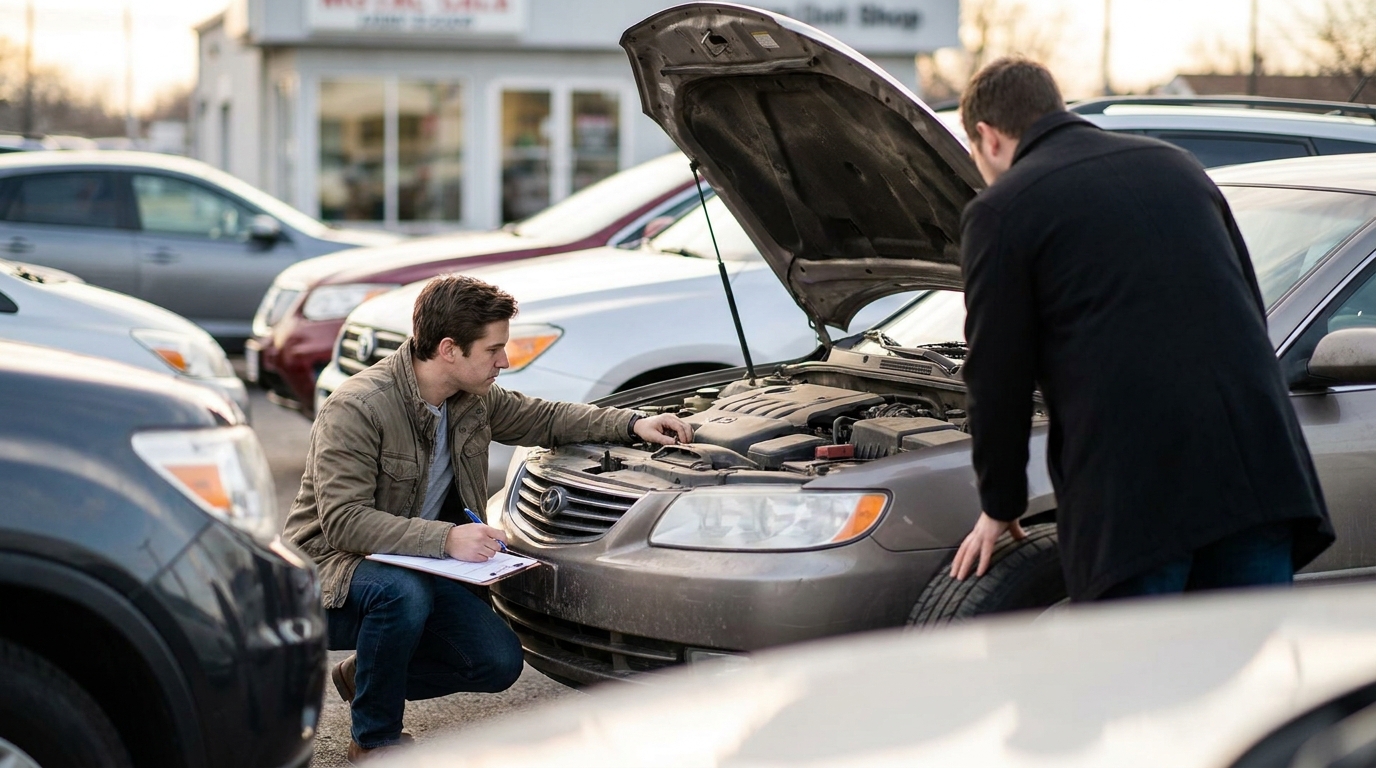
You don't need to be a mechanic to spot warning signs here. You need to be observant.
- Fluid levels and color. Engine oil should be amber to dark brown, not gritty or milky. Milky oil suggests a coolant leak into the engine — a major red flag. Coolant should be the manufacturer's color, not rusty or oily.
- Belts and hoses. Squeeze the upper radiator hose (engine cold). It should feel firm but pliable, not crunchy or spongy.
- Battery. Look for corrosion on the terminals and check the manufacture date. Batteries in our climate typically last four to six years.
- Leaks. Look at the ground under where the car was parked. Fresh oil, coolant, or transmission fluid stains warrant follow-up questions.
- Engine bay cleanliness. A spotless engine on a 90,000-mile car can indicate a recent steam clean to hide a leak. Some dust and grime is normal and actually reassuring.
The Interior Inspection
Sit in every seat. Open every compartment. Test every button.
- Odors. Musty smells suggest water intrusion — common in cars that sat through Missouri storm seasons with a clogged sunroof drain. A heavy air-freshener smell sometimes masks smoke or mildew.
- Electronics. Test the infotainment, Bluetooth pairing, backup camera, all power windows, both front seat heaters, the sunroof, and every USB port. Electrical gremlins are expensive to chase.
- Climate control. Run the AC on max for several minutes. Vent temperature should drop into the low 40s. Then run the heat. Both matter here — you'll use both within the same week in spring.
- Wear vs. mileage. A worn driver's seat bolster and shiny steering wheel on a 40,000-mile car suggests the odometer doesn't tell the whole story.
- Seat belts. Pull each one out fully. They should retract smoothly. Frayed or sticky belts are a safety concern and a possible accident indicator.
The Test Drive
A five-minute loop around the dealership parking lot doesn't count. Plan for at least 20 minutes that includes city streets, a stretch of highway (Lee's Summit drivers can hop on 470 or 50 quickly), and a few stops.
- Cold start. Ask to start the car cold if possible. Many issues — lifter tick, rough idle, smoke from the exhaust — only show up in the first 60 seconds.
- Steering. On a straight, level road, does the car track straight with light hands on the wheel? Pulling left or right indicates alignment, tire, or brake issues.
- Braking. Find an empty stretch and brake firmly from 40 mph. Listen for grinding, feel for pulsing, and watch for pulling.
- Transmission. Shifts should be smooth and predictable. Hesitation, slipping, or hard clunks deserve a closer look. For automatics with a manual mode or paddle shifters, test those too.
- Highway behavior. Get to 65 mph. Listen for wind noise, vibration, and how the car tracks. A vibration that appears at a specific speed often indicates a wheel balance or driveline issue.
The Paper Trail
The vehicle's history matters as much as its condition.
- Vehicle history report. Carfax or AutoCheck reports flag accidents, title issues, and service records. A reputable seller provides one without being asked.
- Title status. Confirm the title is clean — not salvage, rebuilt, or flood. In Missouri, title branding stays with the vehicle, so a flood title from another state will follow it here.
- Service records. A binder of receipts is a green flag. So is a digital service history pulled from the manufacturer's system.
- Outstanding recalls. Look up the VIN at the NHTSA recall site before you buy. Open recalls are free to fix at a franchised dealer.
Get an Independent Pre-Purchase Inspection
For any used vehicle you're seriously considering — especially a private-party purchase — a third-party pre-purchase inspection from a trusted shop is worth the $100 to $200 it typically costs. A qualified technician will put the car on a lift, scan for stored fault codes, and check things you simply cannot evaluate from the ground.
If the seller refuses to allow an independent inspection, that's your answer about the car.
Frequently Asked Questions
What's the most common thing buyers miss?
Undercarriage condition. Most buyers never look under the car, and that's where Missouri winters do their worst damage. A 10-second look at the frame rails and brake lines tells you a lot.
Should I trust a dealer's own inspection?
Reputable dealerships put used inventory through a multi-point inspection before it hits the lot, and many publish that checklist. That's a real benefit — but it doesn't replace your own walk-around. Buyers often tell us they appreciate when the process is transparent; one customer wrote that their experience was "really transparent and straightforward," which is the standard worth holding any seller to.
How do I know I'm getting a fair price?
Cross-reference the asking price against Kelley Blue Book, Edmunds, and current listings for the same year, trim, and mileage within a 100-mile radius. If the price is significantly below market, ask why.
What about certified pre-owned vehicles?
CPO programs from the manufacturer typically include extended warranty coverage, a documented inspection, and roadside assistance. For buyers who want fewer surprises, the premium is often worth it — particularly on European brands where out-of-warranty repairs can run higher.
Does it matter whether I use Carfax or AutoCheck?
Both pull from overlapping but not identical data sources, so neither is complete on its own. Carfax tends to have broader service-record coverage; AutoCheck uses an Experian-based scoring model that weights certain history events differently. When the purchase price justifies it, running both reports is the safest approach — together they close most of the gaps either one leaves on its own.
What should I check on an older high-mileage vehicle that I wouldn't check on a newer one?
Timing belt or chain service history becomes critical past 80,000 to 100,000 miles depending on the engine. Look for evidence it has been replaced on schedule. Also inspect rubber components — CV boots, suspension bushings, and coolant hoses — more carefully, since age and Missouri temperature swings degrade them faster than mileage alone suggests.
The Bottom Line
A careful inspection takes time, but it's the cheapest insurance you'll ever buy. Walk around the car, look under it, drive it on real roads, read the history report, and — if anything feels off — get a second opinion from an independent technician.
Buyers in Lee's Summit who want a transparent process and a knowledgeable team to walk them through a vehicle in person can visit Volkswagen Lee's Summit at https://www.vwleessummit.com. The dealership's 4.5-star rating across more than 5,000 Google reviews reflects the kind of straightforward, no-pressure approach this checklist is designed to help you find — wherever you ultimately buy.
"