Vehicle Safety Features Comparison: Which Cars Have the Best Protection in 2026
Compare car safety ratings, crash test scores, and vehicle safety technology to find the best-protected cars for Lee's Summit drivers in 2026.
If you're shopping for a vehicle in Lee's Summit and safety sits at the top of your list, you're asking the right question first. Modern vehicles vary widely in how well they protect occupants — and the gap between an average crash-rated car and a class leader can be the difference between walking away from a collision and a much worse outcome. With Missouri winters that bring ice on Highway 50, summer thunderstorms that flood low spots near Lake Jacomo, and the daily I-470 commute traffic, the protection your vehicle offers matters every time you turn the key.
This guide walks through how car safety ratings actually work, which vehicle safety technology genuinely makes a difference, and how to compare crash test ratings across the models you're considering.
How Car Safety Ratings Are Determined
Two organizations dominate vehicle safety testing in the U.S., and understanding the difference between them is the foundation of any honest comparison.
NHTSA 5-Star Safety Ratings
The National Highway Traffic Safety Administration runs the federal New Car Assessment Program. Vehicles receive one to five stars across frontal crash, side crash, and rollover tests, plus an overall score. A 5-star overall rating is the benchmark to look for, but pay attention to the sub-scores too — a vehicle can earn 5 stars overall while scoring 4 in side-impact protection.
IIHS Top Safety Pick and Top Safety Pick+
The Insurance Institute for Highway Safety runs a tougher battery of tests, including the small overlap front test, updated side test, and headlight evaluations. The IIHS "Top Safety Pick+" designation is currently the highest bar a vehicle can clear — it requires "Good" ratings across crashworthiness tests, advanced or superior front crash prevention (vehicle-to-vehicle and vehicle-to-pedestrian), and acceptable or good headlights across trim levels.
When we help shoppers at Volkswagen Lee's Summit compare models, we recommend looking at both ratings together. NHTSA tells you how a vehicle performs in standardized crashes; IIHS tells you how it performs in the harder, more real-world scenarios.
The Vehicle Safety Technology That Actually Matters
Modern cars come loaded with acronyms. Here's what's worth prioritizing — and what's mostly marketing.
Active Safety: Features That Prevent Crashes
- Automatic Emergency Braking (AEB): Detects an imminent forward collision and brakes if you don't. This is arguably the single most impactful safety feature added to cars in the last decade.
- Forward Collision Warning with Pedestrian Detection: Especially valuable in stop-and-go traffic around Summit Fair or downtown Lee's Summit where pedestrians cross unexpectedly.
- Blind Spot Monitoring: Critical on multi-lane stretches like I-470 and US-50.
- Lane Keeping Assist and Lane Departure Warning: Useful for highway driving and helpful during winter weather when lane markings can be partially obscured.
- Adaptive Cruise Control: Maintains a set distance from the car ahead — reduces fatigue and rear-end risk on longer drives toward Kansas City or Columbia.
- Rear Cross-Traffic Alert: Warns you of approaching vehicles when backing out of parking spaces, a feature most drivers don't realize they need until they have it.
Passive Safety: Features That Protect You in a Crash
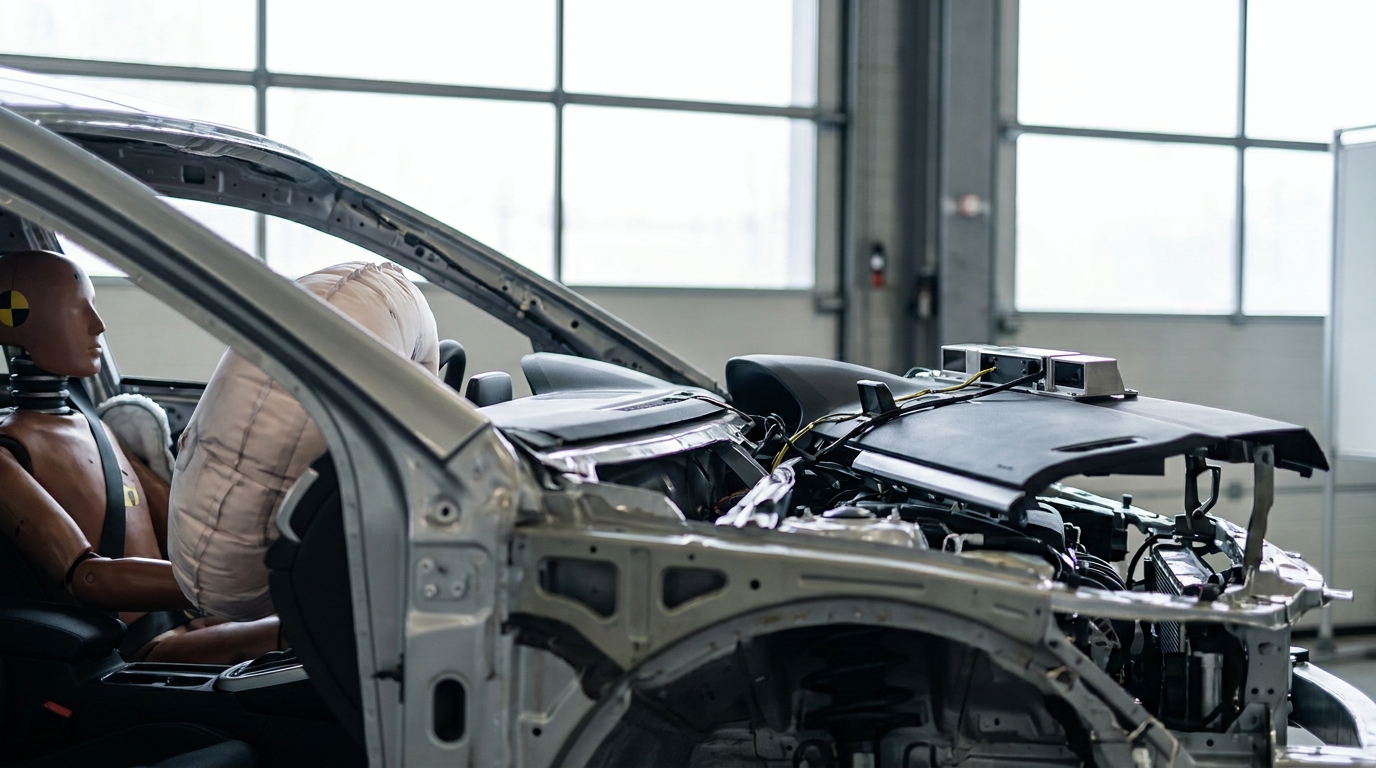
- Advanced airbag systems including front, side, curtain, and increasingly knee and far-side airbags
- Reinforced safety cages built with high-strength steel
- Crumple zones engineered to absorb and redirect crash energy
- Three-point seatbelts with pretensioners and load limiters
How Today's Volkswagen Lineup Compares on Safety
Volkswagen has invested heavily in safety engineering, and it shows in current ratings. The IQ.DRIVE driver assistance suite — standard or available on most current Volkswagen models — bundles adaptive cruise, lane keeping, blind spot monitoring, forward collision warning, and emergency assist into one package.
Models like the Atlas, Tiguan, Taos, and Jetta have consistently performed well in IIHS testing in recent years. When you're comparing a Volkswagen against another make, we encourage you to look up each specific trim on both nhtsa.gov and iihs.org — safety equipment can vary between trim levels, and the base trim of one vehicle may not include the same standard features as the mid-tier of another.
What to Compare When Cross-Shopping for Safety
If you're weighing two or three vehicles, here's the practical comparison framework we walk customers through:
- Overall NHTSA star rating — and the sub-scores, not just the headline number
- IIHS designation — Top Safety Pick+ is the highest current bar
- Standard vs. optional safety tech — does AEB come standard, or only on higher trims?
- Headlight rating — IIHS evaluates this, and poor headlights are a real Lee's Summit issue on dark rural stretches like Pryor Road south of town
- Outward visibility — sit in the driver's seat and check blind spots before you buy
- Child seat anchor (LATCH) ease of use — IIHS rates this separately, and it matters more than you'd think for parents
Safety Considerations Specific to Driving in Lee's Summit
National crash test ratings tell you how a car performs in a lab. Driving conditions tell you what you'll actually face. A few local realities worth factoring in:
Winter weather: Lee's Summit averages multiple ice events between December and February. All-wheel drive availability, traction and stability control calibration, and winter-rated tires all influence real-world safety as much as a crash rating does.
Severe storms: Spring and summer bring tornado watches and heavy hail. Hail damage isn't a crash safety issue, but flooded roadways are — newer vehicles with electronic stability control handle hydroplaning recovery measurably better.
Highway and commuter traffic: The I-470, US-50, and M-291 corridors carry heavy daily traffic. Adaptive cruise and AEB earn their keep on these roads more than almost anywhere else in the metro.
Frequently Asked Questions
Is a 5-star NHTSA rating the same as IIHS Top Safety Pick+?
No. They're different testing programs with different methodologies. The strongest signal is a vehicle that earns both — 5-star overall NHTSA and IIHS Top Safety Pick+.
Are larger vehicles always safer?
Generally, larger and heavier vehicles offer more crash protection in multi-vehicle collisions, but they often have higher rollover risk and longer stopping distances. A well-engineered midsize SUV with strong active safety tech often outperforms a larger vehicle without those features.
Do used cars have the same safety features as new ones?
Often, no. Standard equipment expands every model year. A 2026 model typically includes safety tech that was optional or unavailable on a five-year-old version of the same nameplate. If you're cross-shopping new and used, compare feature lists carefully.
How much do safety features add to the price of a car?
Less than they used to. Many features that were luxury options a few years ago — AEB, lane keeping, blind spot monitoring — are now standard on mainstream trims. The cost gap between a base trim and a safety-loaded trim is often a few thousand dollars, and frequently worth it.
Putting It All Together
The safest car for you is the one that scores well in independent testing, comes equipped with the active safety features you'll actually use, fits the conditions you drive in, and feels right from behind the wheel. Crash test ratings narrow the field; a real test drive confirms the choice.
Drivers in Lee's Summit who want help comparing specific models, decoding trim-level safety differences, or scheduling extended test drives can reach Volkswagen Lee's Summit at https://www.vwleessummit.com. The team is happy to walk through NHTSA and IIHS reports alongside you and pull up the IQ.DRIVE feature breakdown for any model on the lot — no pressure, just a straightforward conversation about what protects you best.